
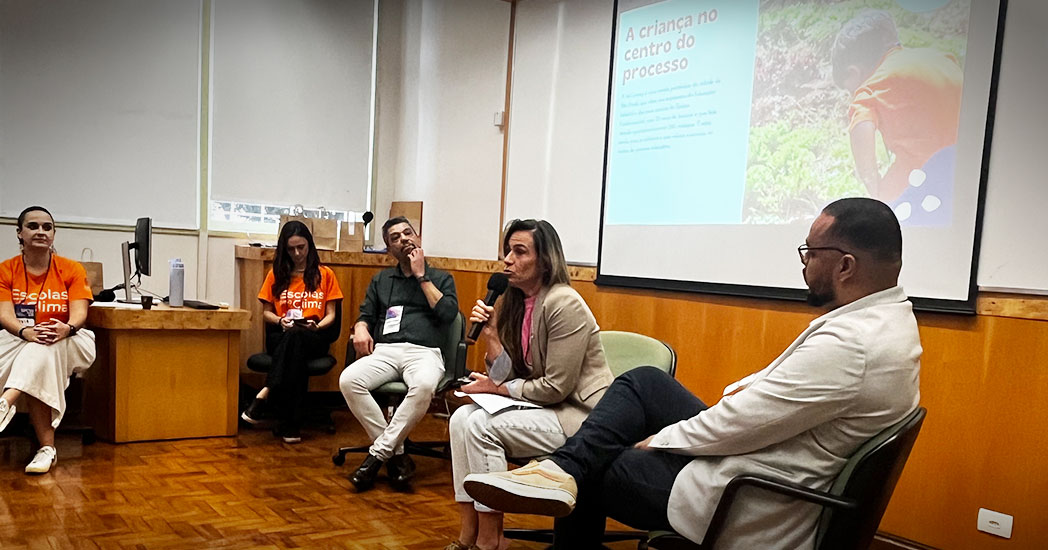
The São Paulo Climate Week 2026, an event promoted by Reconectta and the Schools for Climate movement with the aim of broadening the debate on education, sustainability, and the climate emergency, brought together representatives from different institutions to share experiences and reflect on the role of schools in facing the current environmental challenges. Our Elementary School pedagogical coordinator, Gabriela Fernandes, was invited to join the panel “Climate Education Practices in Schools” and share the paths that be.Living has been building in climate education.
Gabriela began the reflection by proposing to consider what is necessary for climate education to take place consistently within the school. In your view, this work cannot be limited to the initiative of a few more engaged teachers, nor should it appear only occasionally, in projects, on specific dates, or during times when the topic receives greater visibility.
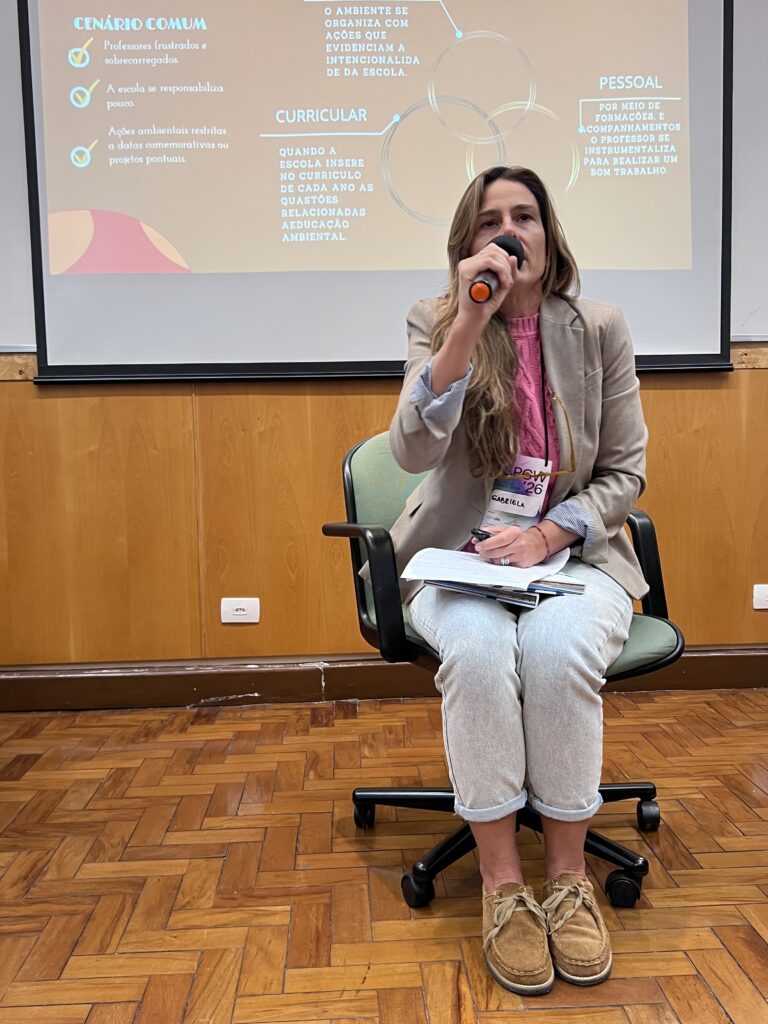
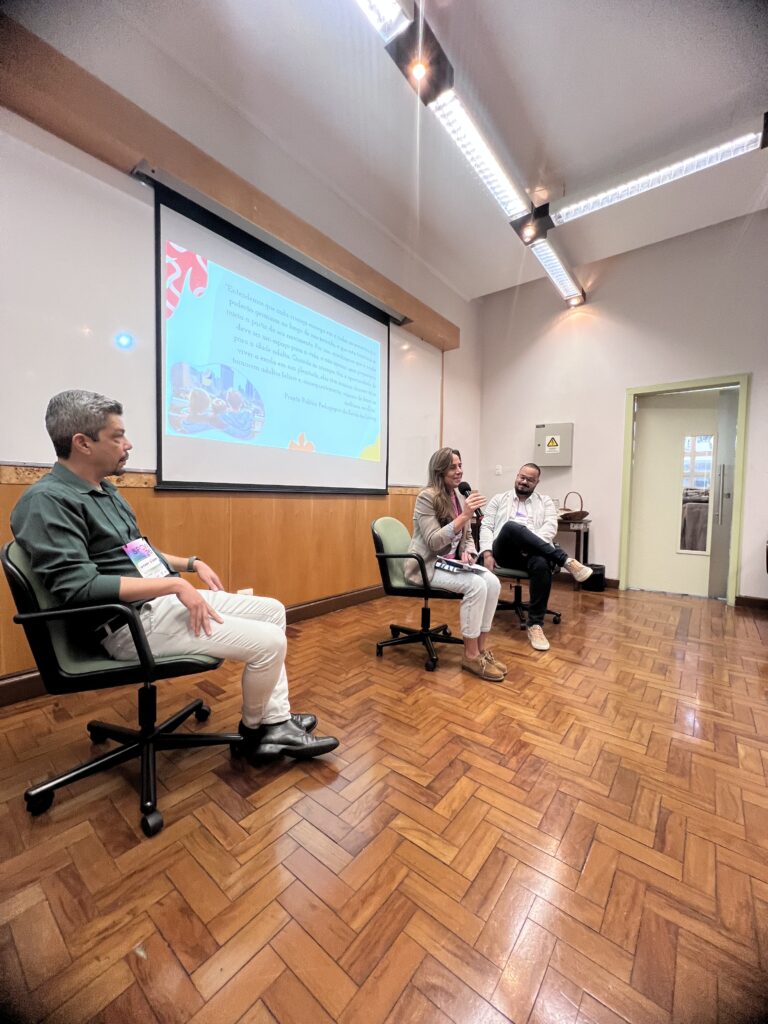
“For this work to happen with strength, it needs to be supported by different spheres of the school. It cannot depend solely on an individual initiative, but rather on a broader organization that provides the conditions for it to be sustained in daily life,” he stated.
Based on be.Living’s experience, Gabriela organized this framework into three dimensions: institutional, curricular, and personal. The institutional dimension concerns the choices made by the school itself and the presence of environmental education in its project. The curriculum ensures continuity and progression of learning throughout the years. On the other hand, the personal aspect is connected to the training of educators, who require repertoire, guidance, and spaces for reflection in order to sustain this work with consistency.
At be.Living, this choice appears both in the Pedagogical Political Project and in daily life. It is present in the school’s natural spaces and in initiatives that involve the entire community, such as waste recycling, Meatless Monday, reducing plastic use, and caring for the Garden and the compost bin. But it is also present in the curriculum and in the way children are invited to observe, investigate, and relate to the world.
“In order for the child to understand themselves as nature, they need to experience nature. The child is nature itself in motion. She experiences the earth with her hands, perceives the texture of the leaves, learns from the rhythm of the seasons, and mirrors herself in the living cycles,” explained Gabriela.
In Elementary School, this perspective is continued through experiences such as monthly assemblies, Science projects, and the Arts and Science Exhibition, the MAC. Held every semester, the exhibition brings together scientific research developed by the children and seeks to ensure that investigating the world also leads to reflection and action regarding the planet. The objective is to articulate fundamental learning skills, such as reading, writing, mathematics, observation, hypothesis development, and research, with the social and environmental issues that are part of life.
This process also requires that the educational team be engaged in continuous learning. At be.Living, training in climate and environmental education takes place with the support of Reconectta and other consultancies that accompany the projects and work directly with the pedagogical teams.
“The training sessions are spaces for listening, studying, planning, and encouragement. When the educator feels confident and passionate about the subject, this passion overflows into the classroom. And the classroom is the school,” he emphasized
More than teaching children concepts about the environment or climate change, the path presented by be.Living begins with the construction of belonging. First to the school and the nearby community. Gradually, to the city, to the country, and to the planet. It is from this daily relationship with others, with the collective space, and with nature that a more conscious and committed attitude toward the world can emerge.
“Environmental Education in childhood is, ultimately, an act of love and responsibility toward humanity. May we continue to cultivate this planet together, day by day, with intention, partnership, and affection,” concluded the coordinator.