

Curiosity and the extraordinary capacity to learn are among the most beautiful expressions of childhood. Children explore, investigate, ask questions, create hypotheses, and construct meaning about the world around them. We understand that our role, as a school, is to welcome and organize this natural process of discovery, broadening possibilities for thinking and fostering the development of each child’s potential.
It is within this context of meaningful learning that we propose bilingual literacy. Since their arrival at school, in Early Childhood Education, English becomes a natural part of daily life. At be.Living, children do not only learn English, they learn in English. Through immersion, they experience activities integrated into their daily school life and build a pleasurable relationship with the language, developing linguistic competencies in English in a manner very similar to what occurs with the Portuguese language.
This is because we understand literacy as a cultural, relational, and investigative process. More than technically learning to decode letters and sounds, becoming literate means engaging in dialogue with language, constructing hypotheses about how it works, producing meaning, and developing resources to understand and communicate about the world.
When this process takes place in two languages simultaneously, the experience is broadened. The children are invited to reflect on the functioning of two distinct linguistic systems, establishing connections, perceiving regularities, identifying differences, and constructing increasingly sophisticated hypotheses about language.
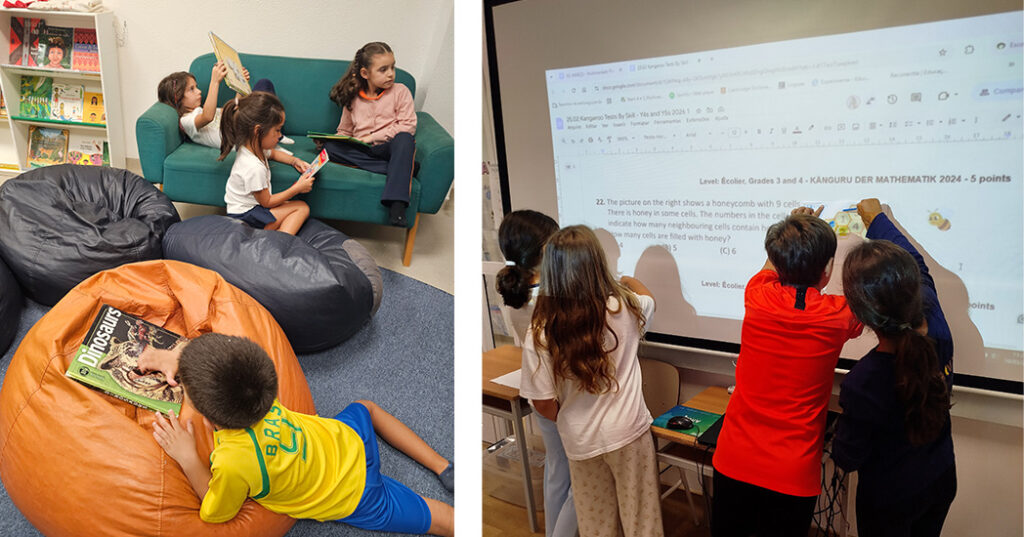
According to the Elementary School pedagogical coordinator, Gabriela Fernandes, it is precisely this broadening of reflection that marks the central difference between bilingual literacy and literacy solely in Portuguese. “In bilingual literacy, the child reflects on the functioning of two systems simultaneously. Although Portuguese and English use the same letters, they organize sounds and structures in different ways. This exercise greatly expands the possibilities for analysis and reflection on the language.”
In practice, this simultaneous contact provokes a type of cognitive conflict that is highly potent for intellectual development. When realizing that the same letter can have different sounds depending on the language, or that each language organizes its sound and structural logic in its own way, the child needs to review hypotheses, reorganize strategies, and build new relationships of understanding.
This experience directly engages with the constructivist perspective that guides the school’s pedagogical work. “We understand that conflict generates reflection, and that reflection generates flexibility. The more flexible the brain is, the more quickly it solves problems in all areas of knowledge and in life.”
This development, however, does not begin only when the child formally starts to read and write. It begins from the moment the child enters the school, when the literacy environment starts to present language as a living experience full of meaning. Signs, names, visual records, routine agreements, and daily interactions immerse the child in a written culture that begins to be observed, recognized, and interpreted from a very early age.
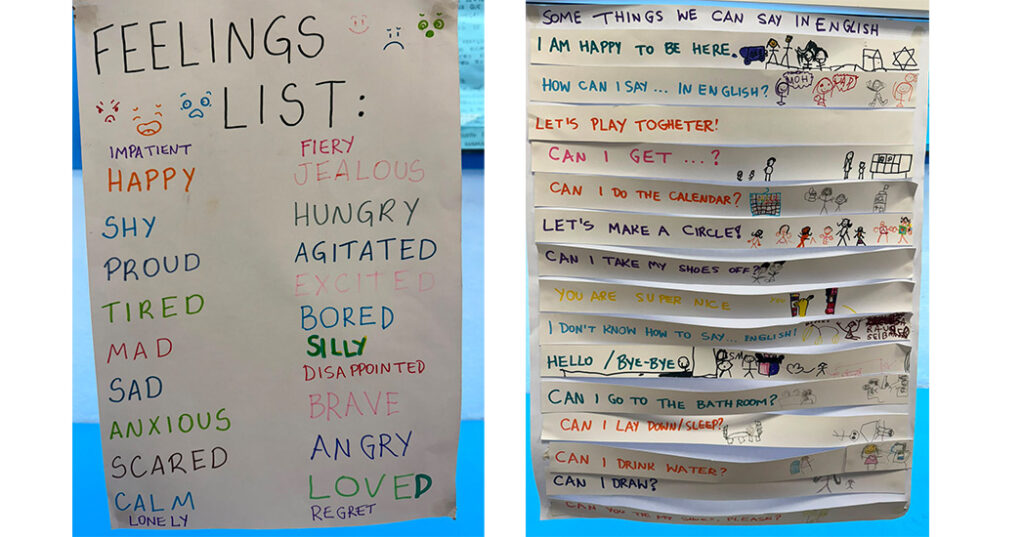
It is in Blue, the final stage of Early Childhood Education, that this relationship becomes even stronger. There, the children begin to be invited to look more closely at how words work, to share hypotheses, to identify letters, to notice regularities, and to build connections between writing and orality.
For Gabriela, this moment should not be understood as a technical anticipation of formal literacy, but rather as a consistent insertion into real reading and writing practices. “We understand that literacy is not a technical learning process. It is a cultural learning process. Literacy occurs when the child engages in dialogue with the text, makes inferences, and understands what they read.”
Therefore, more than establishing rigid competencies to be achieved, the work at this stage is organized around meaningful experiences: leafing through books and narrating stories even without conventional reading, observing stable words from daily routines, identifying graphic similarities between names, and realizing that those signs convey meaning. “These are practices that begin to introduce them to this literate world,” he explains.
Throughout Blue, Portuguese and English are worked on simultaneously by specialized teams, in a carefully structured immersion process. The children recognize that each teacher uses a specific language, and the environment naturally supports this differentiation.
Upon entering Elementary School, this journey acquires a more explicit methodological intentionality. Simultaneity, according to Gabriela, occurs fully, although the prior repertoire in Portuguese, generally broader as it is the language spoken at home, causes many processes to initially appear more strongly in this language. Even so, interferences between the languages are understood as a legitimate and productive part of the learning process. “It is not uncommon to see children writing Portuguese words with hypotheses influenced by English, or vice versa. This shows that they are thinking about how the language works.”
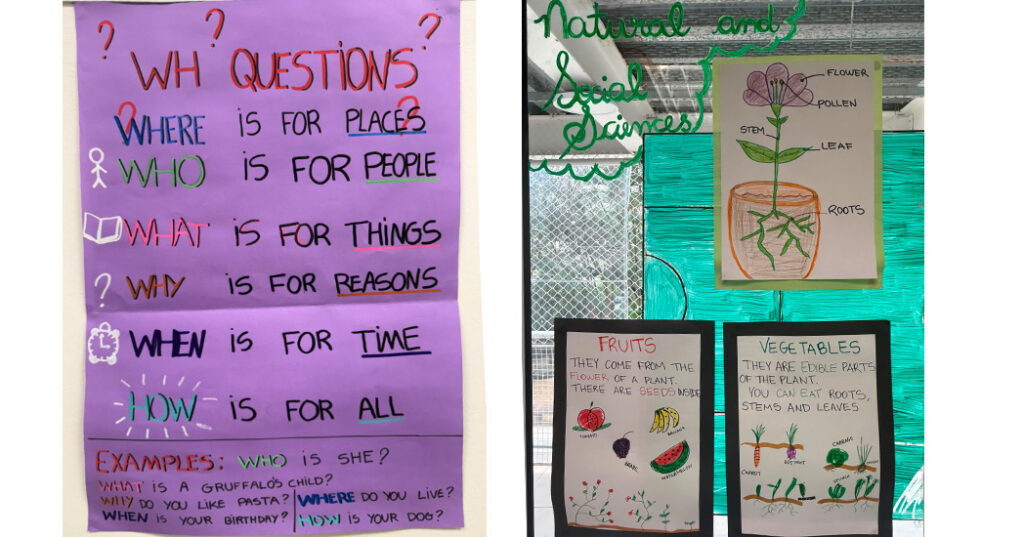
This crossing between languages is strengthened by a pedagogical strategy called translanguage, or metalinguagem. In practice, children are constantly invited to transfer knowledge built in one language to the other. If in the morning they investigated, for example, the germination of a seed in Portuguese, in the afternoon they will be able to explain this same concept in English, cognitively reorganizing what they have understood. “This makes the child realize that they are acquiring knowledge, sometimes in Portuguese, sometimes in English. Language ceases to be merely an object of instruction and becomes a true tool for the construction of thought.”
For this process to occur consistently, the school organizes a unique curriculum, coordinated between the teams of both languages. There is a single learning path in mathematics, natural sciences, social sciences, and language, woven together in an integrated manner so that the content is constructed and revisited in both languages.
When it comes to evaluating this journey, we adopt an equally broad understanding of what it means to be literate. Beyond mechanical reading or written reproduction, literacy is understood as the ability to read, comprehend, infer meanings, and communicate ideas in written form. “For us, a literate child is one who reads, writes, understands what they read, makes inferences, and is able to communicate in writing what they have learned and what they wish to express.”
This monitoring takes place in a procedural and formative manner. Children are observed daily in different contexts of production, reading, and interaction with language. When necessary, the monitoring becomes individualized, respecting individual rhythms and trajectories. “We work with pedagogical differentiation. The proposals are designed for different levels of learning, because each child builds this process in their own time.”
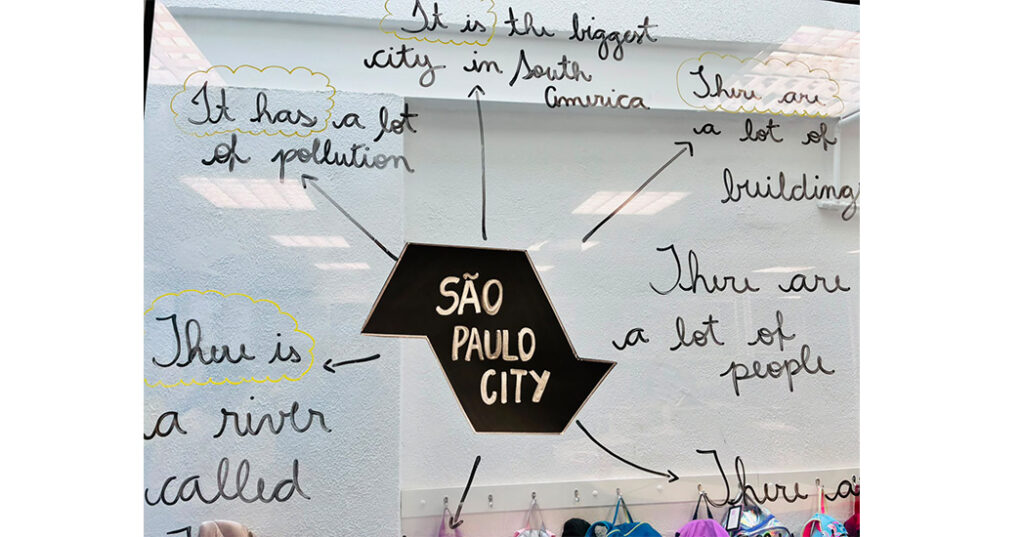
Throughout this journey, the impacts go beyond literacy itself. The bilingual experience broadens cultural repertoire, strengthens cognitive flexibility, and expands possibilities for research, literary reading, and knowledge building. “Bilingual literacy brings a different kind of brain plasticity, offering greater flexibility to deal with content and concepts. We have witnessed children with a very extensive vocabulary, an expanded cultural repertoire, and greater possibilities to access the world.”
Literacy in two languages does not simply mean teaching two ways of writing. It means offering children more ways to think, interpret, create connections, and understand the complexity of the world from different perspectives. It is, in essence, to broaden the ways of reading life.